

2026 Hyundai Tucson vs 2026 Mazda CX-5: Compact SUV Comparison in Alberta
2026 Hyundai Tucson vs 2026 Mazda CX-5: Compact SUV Comparison in Alberta
Posted on June 20, 2026
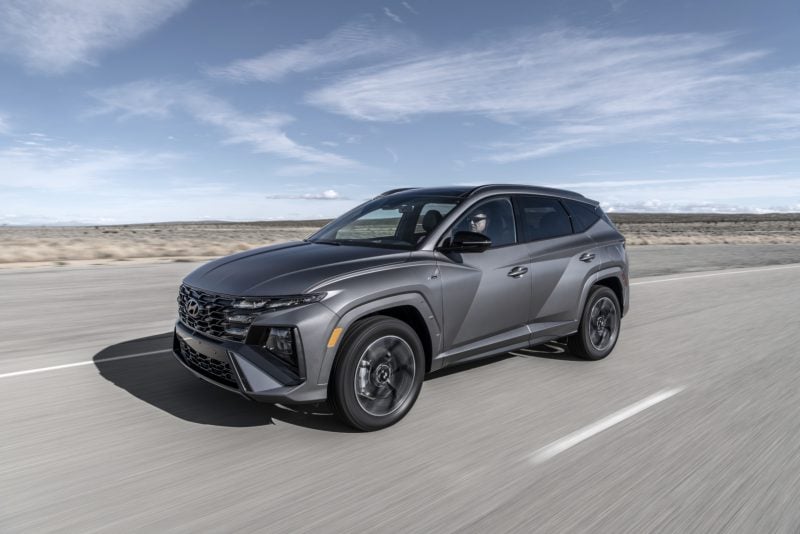
Choosing a compact SUV for Alberta commutes and weekend trips means weighing more than the sticker price. The 2026 Hyundai Tucson and 2026 Mazda CX-5 compete for the same driveway, but they take different approaches to power, safety tech, and long-term ownership.
Here’s how the Tucson pulls ahead on the details that matter most.
2026 Tucson vs 2026 CX-5 at a Glance
| Category | 2026 Hyundai Tucson | 2026 Mazda CX-5 |
| Powertrain choices | Gas, hybrid (HEV), or plug-in hybrid (PHEV) | Gas only (2.5L four-cylinder) |
| Base engine output | 187 hp / 178 lb-ft (2.5L four-cylinder) | 187 hp / 186 lb-ft (2.5L four-cylinder) |
| Combined fuel economy (gas) | 8.8 L/100 km | 9.0 L/100 km |
| Hybrid fuel economy | 6.7 L/100 km (HEV) | Not offered |
| Max towing (gas trim) | 3,500 lbs (1,588 kg) | 1,500 lbs (680 kg) |
| Cargo volume (behind front seats) | 2,119 L | 1,882 L |
| Ground clearance (base trim) | 210 mm | 204 mm |
1. Three Powertrains Give the Tucson More Ways to Save
The 2026 Tucson comes with three distinct powertrains, while the CX-5 sticks to one 2.5L four-cylinder gasoline engine across every trim. Tucson’s base 2.5L four-cylinder Smartstream engine makes 187 hp and 178 lb-ft, close to the CX-5’s 187 hp and 186 lb-ft from its own 2.5L four-cylinder SKYACTIV-G engine.
From there the two lineups split. Step up to the Tucson’s 1.6L turbo four-cylinder hybrid and combined output climbs to 231 hp and 271 lb-ft, backed by a 64 hp electric motor and a 1.49 kWh battery. Choose the plug-in hybrid and the 1.6L turbo four-cylinder engine pairs with a 97 hp electric motor and 13.8 kWh battery for 268 hp combined, plus 51 km of electric-only range from a 7.2 kW onboard charger.
The CX-5 offers none of this. Every trim runs the same naturally aspirated engine, with no hybrid or plug-in option in the 2026 lineup. A commuter chasing lower fuel bills or a family wanting electric-only range for short trips both get a lane on the Tucson; the CX-5 offers a single lane for everyone.
2. A Deeper Layer of Driver-Assist Tech
Both vehicles start with a strong base of driver-assist tech. The CX-5 standardizes blind-spot monitoring with exit warning, smart brake support, and traffic sign recognition with radar cruise across its GX, GS, and GT trims. The Tucson matches that everyday layer with standard forward collision-avoidance covering pedestrians, cyclists, and junction-turning, lane keeping and following assist, blind-spot warning, rear cross-traffic warning, and stop-and-go adaptive cruise on every trim.
The two lineups part ways at the top of the range. Tucson’s top trim adds Highway Driving Assist, a Blind View Monitor, a Surround View Monitor, front/side/reverse parking distance warning, reverse parking collision-avoidance, and remote smart parking assist, all bundled into the trim itself. The CX-5’s closest equivalent, its 360° view monitor, needs a Premium Package added to the range-topping GT before it’s available at all.
Top-trim tech exclusives on the Tucson: - Highway Driving Assist for lane centring on the highway - Blind View Monitor with a live camera feed in the cluster - Surround View Monitor for tight parking - Remote Smart Parking Assist
3. A Warranty Built for Long-Term Ownership
Hyundai backs the 2026 Tucson with a 3-year/60,000 km new vehicle limited warranty, a 5-year/100,000 km powertrain warranty, and 5-year/100,000 km roadside assistance. Corrosion coverage runs 3 years/60,000 km for surface rust and 6 years/160,000 km for perforation.
That combination lowers the financial risk of owning a hybrid or plug-in hybrid, since the powertrain warranty covers the electric motor and battery system alongside the engine and transmission for as long as most owners keep a compact SUV.
Who the 2026 Tucson Fits Best
The CX-5’s cockpit earns real praise: a driver-focused layout, up to a 15.6-inch touchscreen on its top trim, and Google built-in for hands-free voice control. But that refined layout still sits behind a single 2.5L gas engine with no hybrid or electric-range option, so drivers who want to cut fuel costs or add electric-only commuting have nowhere to go inside the CX-5 lineup.
Families managing school runs and weekend trips get more flexibility from Tucson’s three powertrains, its 2,119 L of cargo room behind the front seats, and a 3,500 lbs (1,588 kg) towing rating on the gas model for trailers or gear. Commuters chasing lower fuel bills can step into the 231 hp hybrid or the 51 km electric range of the plug-in hybrid, both covered by the same 5-year/100,000 km powertrain warranty as the base engine.
Buyers who want their next compact SUV to keep pace with rising fuel costs or a move toward part-time electric driving find that flexibility already built into the Tucson lineup, not held back until a future redesign.
A Compact SUV Built to Keep Up
The 2026 Tucson pairs three powertrain choices, a deeper driver-assist package on its top trim, and a five-year, 100,000 km powertrain warranty with everyday practicality like 2,119 L of cargo space and a 3,500 lbs (1,588 kg) tow rating on the gas model.
Visit Sherwood Park Hyundai in Sherwood Park to see the 2026 Tucson’s hybrid and plug-in hybrid options in person and find the trim that matches how you drive.