

2026 Hyundai Kona vs 2027 Kia Seltos: Why Kona Is the Better Small SUV in Alberta
2026 Hyundai Kona vs 2027 Kia Seltos: Why Kona Is the Better Small SUV in Alberta
Posted on August 10, 2026
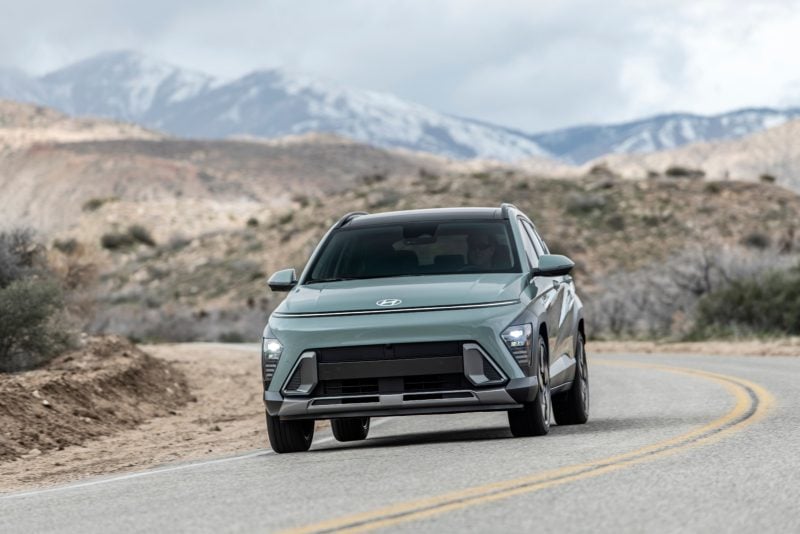
Alberta shoppers cross-shopping subcompact SUVs keep circling back to two familiar names: the Hyundai Kona and the Kia Seltos. Both come from the same corporate family and share engine architecture, so the real differences show up in how each brand builds around that shared foundation.
The 2026 Kona pulls ahead once you look past the shared hardware and into design details, standard technology, and how the cabin actually works day to day.
Kona vs. Seltos at a Glance
| Spec | Hyundai Kona | Kia Seltos |
| Ground clearance (top AWD trim) | 210 mm (N Line Ultimate) | 160 mm (X-Line AWD) |
| Naturally aspirated engine | 147 hp / 132 lb-ft (2.0L) | 147 hp / 132 lb-ft (2.0L) |
| Turbocharged engine | 190 hp / 195 lb-ft (1.6L Turbo) | 190 hp / 195 lb-ft (1.6L Turbo) |
| Wheelbase | 2,660 mm | 2,690 mm |
| Cargo, behind rear seats | 723 L | 786 L |
| Cargo, seats folded | 1,803 L | 1,817 L |
Design and First Impressions
The Seltos arrives with Kia’s “Opposites United” design direction: flush door handles, a vertical grille, and a boxier, floating-roof profile that reads more upright than the outgoing model. The X-Line trim layers on piano-black and gun-metal accents plus new Terrain Brown and Frost Blue paint options.
The Kona answers with its own visual identity, especially on N Line and N Line Ultimate trims. A unique front fascia, grille, and rear diffuser come standard, paired with red interior stitching, metal sport pedals, and 64-colour ambient lighting inside. It is a cabin built around personal touches, not just a badge swap.
Powertrain and Drivetrain
The Kona offers two engines. A 2.0-litre four-cylinder makes 147 hp and 132 lb-ft through an Intelligent Variable Transmission, standard on Essential, Preferred, and Preferred Trend. A 1.6-litre turbo delivers 190 hp and 195 lb-ft through an 8-speed automatic with SHIFTRONIC manual mode and paddle shifters, standard on Preferred Sport, N Line, and N Line Ultimate. HTRAC all-wheel drive is standard on those higher trims and available on Essential and Preferred.
The Seltos mirrors that shared engineering closely: the same 147-hp, 132 lb-ft 2.0-litre four-cylinder, and the same 190-hp, 195 lb-ft 1.6-litre turbo paired with an 8-speed automatic on X-Line trims. Kia has also confirmed a third Seltos powertrain, a 1.6-litre hybrid with an available e-AWD system, though its output and fuel-economy figures have not been published yet.
With that hybrid still an announcement rather than a spec sheet, every Kona engine on sale today comes with rated fuel economy attached. The 2.0L Essential with front-wheel drive posts 7.5 L/100 km combined (8.1 city, 6.8 highway) for commuting-focused driving, while the 1.6T in N Line and N Line Ultimate trims delivers a livelier drive at 9.1 L/100 km combined.
Cabin Tech and Everyday Convenience
The Seltos X-Line Limited brings a 12.3-inch instrument cluster, a 12-inch touchscreen, and a 5-inch head-up display, plus a 12-speaker audio system, genuine strengths on its top trim. Wireless Apple CarPlay and Android Auto are standard across the Seltos lineup.
The Kona spreads its tech further down the trim ladder. A 12.3-inch touchscreen with wireless Apple CarPlay and Android Auto is standard from the base Essential trim through N Line, not held back for a flagship-only bundle. N Line Ultimate steps up to a navigation-equipped 12.3-inch ccNC display paired with an 8-speaker Bose system and external amplifier, plus Digital Key 2 and wireless device charging standard from Preferred Trend upward.
Cargo, Ground Clearance, and Everyday Practicality
The Seltos edges ahead on outright cargo room: 786 L behind the rear seats and 1,817 L with them folded, against the Kona’s 723 L and 1,803 L on the same basis. Its longer 2,690 mm wheelbase also nets more rear legroom.
The Kona counters where it matters for rough pavement and tight parking: a 210 mm ground clearance on N Line trims versus the Seltos X-Line’s 160 mm, plus a standard dual-level cargo floor across every trim and a proximity-activated smart power liftgate from Preferred Trend up. A tighter 5.3-metre turning radius on N Line Ultimate also makes it easier to place in compact lots.
Safety and Driver-Assist Confidence
The Seltos EX Premium AWD carries a strong standard roster: Smart Cruise Control with Stop & Go, advanced forward collision avoidance with junction turning, and Highway Drive Assist.
The Kona builds that kind of coverage into its entry point instead of reserving it for a mid-tier trim. Blind-spot collision warning, rear cross-traffic alert, lane following and lane keeping assist, driver attention warning, rear occupant alert, and high-beam assist are all standard from the base Essential trim onward. Highway Driving Assist and the full parking-assist suite, including surround and blind-view monitors, arrive on N Line Ultimate.
Why the Kona Fits Alberta Drivers
For Alberta buyers weighing these two, the Kona’s case comes down to what you get without waiting or trading up. Its full SmartSense suite is standard on the base trim, not saved for a package deal, and its ground clearance gives it a real edge over curbs, gravel shoulders, and uneven lots.
Both Kona engines are on sale today with published output and fuel economy, while the Seltos hybrid remains an announcement without confirmed numbers. Add the N Line’s standard personalization, red stitching, ambient lighting, sport pedals, and the Kona reads as the more complete package for a younger, feature-focused small-SUV buyer right now.
Take the 2026 Kona for a Drive
The 2026 Hyundai Kona pairs a choice of two fully specified engines with standard driver-assist technology and N Line design details that carry through the cabin. It is built for buyers who want capability and personality without compromise.
Visit Sherwood Park Hyundai in Sherwood Park to see the 2026 Kona’s trim lineup in person and find the configuration that matches how you actually drive.